

.png)
Exercise Stress Echo
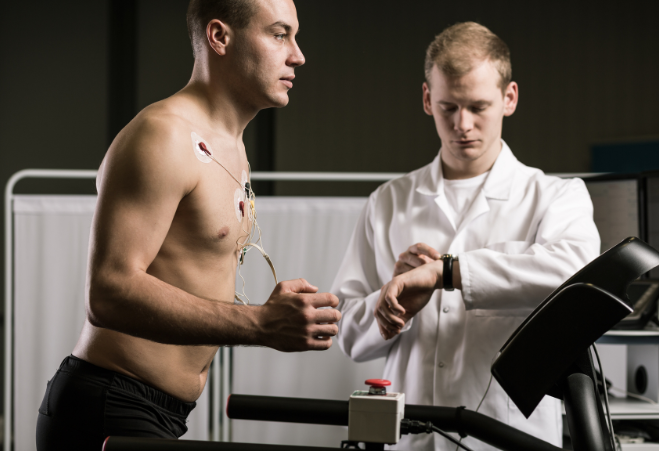
The patient will be asked to complete a regular treadmill exercise test, while their ECG, heart rate and blood pressure are recorded. After the treadmill exercise test, the patient will be quickly moved back to the patient bed and the heart will be looked at again for any sign of abnormal activities.
CardioScan Aotearoa’s stress echo reports are signed off by a New Zealand clinical specialist.
Service and Device Features

All exercise stress echo reports are QA checked and signed off by a New Zealand clinical specialist
Exercise Stress Echo FAQ's
ECG, heart rate and blood pressure recording during treadmill exercise test.
The Exercise Stress Echo at CardioScan Aotearoa provides real-time imaging of the hearts structure and function by combining treadmill exercise with an echocardiogram, offering higher sensitivity (80 - 85%) and specificity (84 - 96%). It provides a detailed assessment of cardiac function and is better suited for patients with ECG abnormalities or limited mobility, though accuracy may be reduced in obese patients and it requires skilled personnel.
Stress Echo allows for dynamic assessment during stress, providing immediate feedback on changes in cardiac function, wall motion abnormalities, and response to stress that exercise ECG alone cannot offer.
Stress echocardiography (Stress Echo) often provides higher sensitivity and specificity compared to exercise ECG (ETT) alone. This means it can be more accurate in detecting CAD or evaluating cardiac function under stress conditions.
Echocardiography provides real-time imaging of the heart's function and structure using sound waves (ultrasound). This can give additional information about wall motion abnormalities, valve function, and overall cardiac performance, which ETT cannot provide.
People with obesity or musculoskeletal limitations may also not be able to exercise adequately for an ETT.
All Exercise Stress Echo studies are reviewed by a Cardiac Physiologist and signed-off by a New Zealand based Cardiologist.
Exercise Stress Echo
Resources
Other Services
Learn more about our other services.
Ambulatory Blood Pressure Monitoring
CardioScan Aotearoa’s 24 hour Ambulatory Blood Pressure Monitoring (ABPM) and reporting service provide interval measurement over 24 hours, for a full diagnostic assessment of a patients blood pressure, accommodating circadian rhythm and white coat or masked hypertension.
ECG Tests
CardioScan Aotearoa offers a 12-Lead, multichannel ECG reporting service with reports signed off by a New Zealand clinical specialist.
Holter Monitoring
CardioScan Aotearoa offers Holter monitoring and reporting solutions, with multi-channel options and the ability to complete studies for up to 14 days. All electrodes are breathable, patient-friendly and also available in paediatric and neonate sizes.
.png)